
Wednesday, December 19, 2012
Six Effective Ways to Foster Innovation
Employee creativity and innovation are essential for the success of any business, particularly in times of economic turmoil. There is a clear connection between employee engagement and innovation according to a poll recently. Engaged employees are more creative and more willing to accept innovative ideas from others. Most CEOs value creativity and employees who are allowed to be creative are more engaged with their current positions. A company’s culture can either foster or stifle innovation. Fortunately, business leaders are able to shape a more creative work environment if they follow a few basic guidelines.
Maintain an open dialogue between employees and upper management
Dialogue will effectively motivate and engage employees. Always allow employees to present their ideas before important decisions are made. Provide feedback to employees, even when their ideas are not used, so that they know that they are not being dismissed.
Encourage communication between departments: Collaboration between members of different departments often results in creative solutions for problems. Interdepartmental communication facilitates trust and prevents conflict. Departments that do not communicate are more likely to blame each other when problems arise.
Organize brainstorming sessions
If to mention names, I did indicate MTN, Globacom, Airtel and Etisalat to mention but a few has found the innovation in the telecom sector to be quite successful. Since 2001, telecom have allowed hundreds of thousands of MTN employees around the African populace to connect and come up with innovative solutions for company problems. You do not need to run a global enterprise to benefit from companywide collaboration. Give your employees regular opportunities to bounce ideas off each other.
Engage employees by encouraging them to share creative ideas
Do not limit creativity to special occasions. Employees should be encouraged to continually share their ideas with supervisors and each other. Find the most effective method of communication for your organization. You may want to create a type of suggestion box or schedule time at the end of meetings for people to share their ideas.
Do not force people to be innovative
Creativity can be encouraged but not compelled. Forcing people to present creative ideas at certain times will not bring true innovation. Rather, create a number of different incentives to draw out creativity. Innovative ideas could be rewarded financially, with opportunities for advancement or any other incentive you have found effective for your employee base.
Remain flexible and forgiving
Inflexible environments discourage innovation. Innovation often involves taking risks. Encourage employees to think outside the box and implement ideas without interference. Additionally, do not punish employees if ideas are unsuccessful. Employees who are punished for taking risks serve as a warning to others against being creative or innovative.
Keep track of company innovations
Many leaders in upper management lose interest in supporting creativity and innovation because they do not bother to keep track of past innovations. Knowing how many employee innovations have been implemented and how successful they are, presents a clear picture of the financial benefits of employee creativity. Keeping track of innovations will also indicate whether any alterations need to be made to recently implemented programs or the company culture.


Friday, December 14, 2012
Socialization
Process by which individuals acquire the knowledge, language, social skills, and value to conform to the norms and roles required for integration into a group or community. It is a combination of both self-imposed (because the individual wants to conform) and externally-imposed rules, and the expectations of the others.
In an organizational setting, socialization refers to the process through which a new employee 'learns the ropes,' by becoming sensitive to the formal and informal power structure and the explicit and implicit rules of behavior.
Socialization is in the HR, Recruiting, Teams, & Training subject.
Socialization appears in the definitions of the following terms: knowledge creation, acculturation, orientation, and entertainment expenses.


Monday, December 10, 2012
Leadership and Personalities, what Alignment?
Leadership strategies are those actions that promote the creation of a unique and valuable market position through a system of activities that complement one another towards achieving the end goal. Often seen as a collection of informed choices, trade-offs and deliberate deviations from the norm, leadership strategies help determine where the opportunities lie and what you can do to best exploit them.
In many cases, leadership strategies are the groundwork for a community, state company, or nation’s strategic plan and must therefore remain at the forefront when setting organizational goals to drive each segment concerned. But as addressed in Strategic Leadership for Executives, there are two primary branches of leadership – analytical and human – that serve as a framework for operational approach. And the choice of analytical over human is often the result of an individual’s personal strengths and weaknesses in the multi-layered aspects of office or business.
Matching strategy with Personality
Strategic leadership is often practiced by those who run large companies, managing thousands or hundreds of thousands of people throughout an extensive organization. To accomplish this task effectively, the leader must possess a refined set of skills geared toward achieving the end goal. And while it’s not necessary that he or she possess all traits, most will find a high degree of competence and comfort in the areas in which they naturally excel.
Consider the following traits and their respective leadership strategies.
Visioning and the Autocrat
The term visioning refers to the initial spark of an idea, the moment that represents the start of any strategic plan. Once the leader has outlined strategic goals, all members of the organization or cabinet must work toward those goals, using all possible influence and resources to accomplish the changes necessary to support the larger plan. And though a leader’s strategic plan is often unique, it must also be relatable enough and have enough internal and external support to enable those who follow to think along the same lines.
Without commitment, success is unlikely.
Visioning is a common trait to most high-level executives or public offices holders, but some are not able to achieve as much success with it in comparison to others – in particular, the autocrat.
The autocrat manages by telling people what to do and when to do it. Often referred to as a “micro-manager,” the autocrat possesses little confidence in subordinates and may even distrust them. In select instances, such as military or law enforcement applications, this approach may actually save lives and therefore serves as the best leadership strategy. However, in the corporate and public world, this managerial style is often viewed as stifling and almost always fails to entice the commitment required to achieve the optimal levels of creativity and innovation. Within this system, employees are unable to make decisions on their own, preventing not only their personal growth but also the sharing of valuable insight and creative ideas. As a result, an autocrat’s visioning typically produces little more than a high rate of employee turnover.
The benevolent autocrat who employs ‘command and control’
Command and control sounds like a tactic the autocrat would employ… and even enjoy. But it actually has little to do with micro-management and more to do with fostering an environment that provides the necessities that allow the organization to achieve its goals. Focused heavily on creativity and innovation, command and control establishes a framework for achieving goals and then creates organizational networks that elicit the best from its people.
Within this framework, the benevolent autocrat succeeds, primarily because they’re the driving force behind this particular employee-driven brand of corporate culture. The benevolent autocrat is typically someone who prefers to function as a coach or mentor to subordinates and frequently disseminates tasks to a wide range of people to maximize the organization’s talent. This individual makes important decisions then works toward convincing subordinates to go along, a process that has been shown to build an organic level of commitment at all levels of a company. Though the benevolent autocrat will often use rewards to motivate personnel, he or she may also use punishment, a practice that is viewed as counter-intuitive to modern strategic leadership.

Thursday, November 8, 2012
How Small Business Culture Can Create Success
What do you think of when you think about small business culture? It can mean many things depending on who you talk to. It can be a “brand,” motto, values, uniforms, or behaviors. It could also be service level, return/exchange policy, or customer appreciation gestures. Do you think of Main Street USA, with all the “Mom n’ Pop” shops on both sides of the street? Do you think about a small business doing business out of a garage?
Culture is a set of attitudes, beliefs, behaviors, and customs. These cultural cues are ingrained in the members of the business, team, or group, and then accepted as the norm. Beliefs about the role of the business, and how business activities fall into this understanding of culture, is typically dictated by how employees interact within their own cultural boundaries. Small business culture will determine what kind of customers it attracts, the service it delivers, and its growth.
Customs of a business culture might be dress code, communication style, physical environment, or even the level of formality. Dress code in the workplace projects an image about the company, to potential and current customers. If a business doesn’t have a dress code, employees will certainly attempt to wear whatever they deem to be appropriate, and this may not always be acceptable. Customers do not want to feel like they are giving their hard earned money to a business that doesn’t care about its image. In a business to business relationship, it is important to understand that each party is a reflection of the other. Business owners/managers should always protect their interests by having a written dress code policy, otherwise the business might suffer.
Communication style (in the literal sense) is another custom that reflects onto the business. If communication within an organization is relaxed and unprofessional, the same will occur when meeting with customers. Maintaining professional dialogue will also minimize the chance for harassment charges. Communication style in the functional sense is an important part of a business’ success. If communication breaks down within an organization, service and sales will be compromised. Businesses should set forth expectations for communication protocol, in order to prevent lost sales.
Most successful business leaders would agree that the physical environment of a business can make or break the bank. In a retail environment it is crucial to have an inviting environment, which includes clean, uncluttered, and safe. Not many consumers will frequent dirty, cluttered, and unsafe establishments. A good rule to follow when creating business culture, especially in retail, is “Straight is clean, Crooked is dirty”.
In a manufacturing environment, clean, safe, and uncluttered are equally important to the success of the business. If the physical environment in a manufacturing plant is not maintained, morale tends to be bad, and accidents are frequent. Morale and injuries tend to go hand in hand, and both affect the company’s bottom line. A business that creates a culture of cleanliness will also experience better morale and fewer accidents as employees will be more inclined to maintain a clean environment.
Professional office environments must also be maintained and inviting, otherwise customers will likely avoid visiting or directing new business to the company. Most people clean their homes before inviting guests, the same should be true in the workplace.
Attitudes, beliefs, and behaviors are related, and have a huge impact on business culture. Is there a difference between large business culture and small business culture? The answer isn’t easy.
 Large businesses have usually established through expensive media campaigns, and large cash outlays for remodels, uniforms, or other things that will help them establish their “brand” or culture. However, despite these investments, they may be challenged by employees that don’t buy into the campaign. The customer may easily identify the culture to the business, but that doesn’t guarantee employees will deliver according to the cultural context.
Small businesses on the other hand may not have the resources for expensive media campaigns, etc. but since they are smaller in employee numbers, the employees tend to be more invested. Small businesses pride themselves on customer intimacy, less bureaucracy, and ability to “walk the talk”. Employees in small businesses tend to share the same understanding of goals, processes, and expectations.
Large and small business cultures require the same ingredients, just on different levels. Both require established dress codes, communication processes, clean facilities, and most importantly, EMPLOYEE ENGAGEMENT. If employees don’t buy into the company culture, everything else is wasted. Company culture should begin in the early stages of training, train to retain employees that believe in the company culture. Employees that believe in the company culture will also live and share it with others.

Managers or Leaders, which is the way? – Francis O.A.
Managers or Leaders, which is the way?
As dictionary defines, DNA means substance carrying organism's genetic information: that is the major component of chromosomes and carries genetic information.
DNA, which is found in all living organisms except some viruses, reproduces itself and is the means by which hereditary characteristics pass from one generation to the next.
Full form deoxyribonucleic acid. Another meaning says: Makeup of something: the combination of features that make something what it is i.e. The company or Individual clearly has success in its DNA.
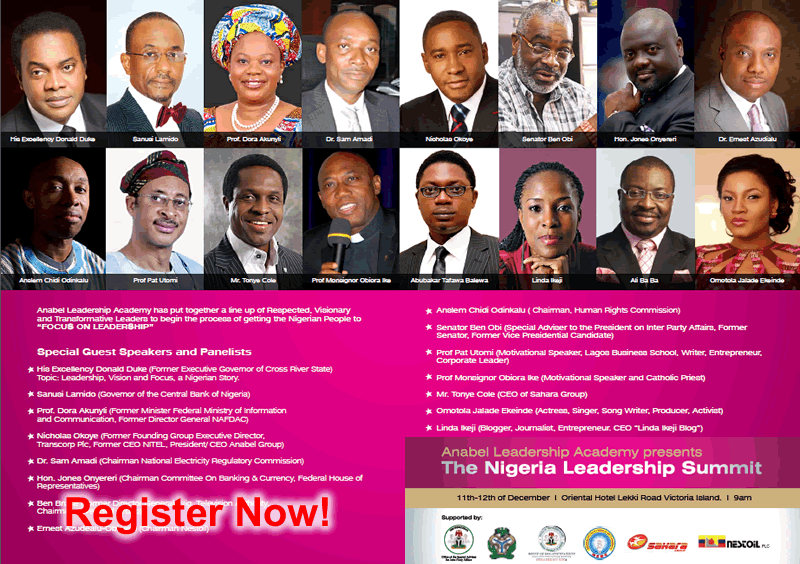
The DNA in Dora Nkem Akunyili that this country needs to tap into are countless, this present generation needs the robust pedigree of such a one like DNA – Dora Nkem Akunyili to be able to fulfil the saying: we are the leaders of tomorrow.
Management and leadership skills are often regarded as one and the same to many businesses. While the two inherently share many similar characteristics, they differ in that not all managers are leaders, but all leaders are managers. There are complementary qualities inexorably linked to each other, and any attempt to extricate one from the other is impossible. Whereas the manager exists to plan, organize and coordinate, a leader serves to inspire and motivate. Militarily speaking, a manager is the battlefield general while the leader is the commander-in-chief.
Qualities of a Manager
A manager is considered a copy of the leader, responsible for communicating the rules and philosophies of the family, society, nation and the cosmos at large, and insuring that they abide by them. For a manager, his or her relationships with employees are determined by a hierarchical management system, and rarely through personal ones. They are responsible for maintaining the day-to-day operations of the sector which they belong so the cogs of the operation stay well-oiled. Managers are generally more concerned with the quarterly bottom line, and will often base decisions on these calculations. Good managers are often considered “good soldiers” in that they rarely question the decisions of the higher echelons of the family, company, or nation and only serve to enforce the execution of its policies.
Qualities of a Leader
In contrast, a leader focuses on interpersonal relationships with other important contacts in other industries, as well as promoting promising individuals within the same to foster innovation. A leader bases his or her decisions on reports from department heads to assess the entire company’s situation, and future strategies. A true leader will also be willing to ignore the company’s quarterly bottom line for several quarters – much to the chagrin of shareholders – and make investments for a long-range growth perspective. A leader is considered a “fearless innovator” in that he or she challenges the status quo and is unafraid to take high risks in search of high rewards, for customers, employees, shareholders alike and the general masses.
Comparison between Managers and Leaders
 It is said that a manager asks “how” and “when”, whereas a leader asks “what” and why”. In many professions, managers and leaders assume the same role. However, if a leader of a ministry or business simply manages its field – rather than challenge its true potential – then it will likely fall behind its industry peers. Likewise, if managers overstep their bounds and attempt to revolt against the company, then they may soon find themselves out of the job. In some cases, where micromanagement is essential to maximize efficiency, nurture skills and keep employees organized, strong managers are an absolute necessity to prevent high turnover rates and the “brain drain” of a skilled workforce and impact on the populace. A good leader will also stay in the front line of battle, and be familiar with every aspect of the company, leading through inspiration rather than coercing through hierarchical control. A perfect manager who attains the status of a true leader will be able to lead people effectively and draw on the correct strengths and knowledge of every key individual in the company. Many managers will struggle for their entire careers and never attain this, but a skilled few will evolve into true leaders.
What we have in both public and private sectors in Nigeria today are managers, who are only but there as figure heads while the leader who determines what be and be not are in the closet. The true ones who has served and possessed the wit of a true leader to serve and impact proactively on our nation are deprived of the position and the fear-dogs would not allow for justice to reign in the name of euphoric state of last-minutes grab and go.
Leaders are what this nation is urgently crying for, not for present state of the nation but for the posterity, let’s give room for change, let’s implement the change now as good people, great nation.
God bless Mr. President, God bless the Federal Executive Counsel Board, God bless the Citizens of Nigeria, and God bless Nigeria.
Saturday, September 29, 2012
Marketing Basics for the Novice Entrepreneur
For the budding entrepreneur, marketing a finished product can be a nightmare. The manpower and capital required to successfully market a product can be impossible for a tiny startup. How can a novice entrepreneur gather the resources necessary to successfully market a product?
Initial Steps
The three initial goals of marketing should be clear to the entrepreneur.
Establishing and increasing the customer base
Increasing the product sales per customer
Increasing the sales of more expensive, higher margin products per customer
Develop a Marketing Plan
Large companies usually tackle the first hurdle through expensive advertising campaign. But let’s assume you don’t have the millions necessary to launch large scale television, print and online media campaigns. We have to start small, with a basic marketing plan. A good marketing campaign should consist of the following:
Target demographics
Seasonal demand
Advantages over competitors
Product pricing and margins
A simple message delivered via an effective advertising strategy
If you have trouble drafting a coherent marketing plan, you can conduct public surveys to gauge the public reaction to your products or services. Make sure your survey is given to a diverse group – in ethnicity, gender, age, income and education level – to get the best sample. These are separated into two kinds – quantitative and qualitative. Do you want quality over quantity, or vice versa? Both have distinct advantages.
Quantitative surveys are fixed questionnaires which can be conducted face-to-face, through e-mail, or over the phone. Try to collect a large number of surveys to gauge the customer response as a kind of vote. Quantitative surveys are good for graphs and estimates.
Qualitative surveys focus on a smaller number of people, without fixed questions. They are usually conducted as face-to-face interviews, conversations or focus groups, where the participants engage in free-form discussion about a topic. Qualitative surveys can help you get a better, more detailed response regarding your product, but can also be extremely time-consuming.
Most successful businesses use a combination of both for the best results. However, if you are pressed for time (and patience), a quantitative survey can be faster and offer similar results with far less manpower and time.
Determine Advertising Mediums and Budget
Now that you have drafted a marketing plan, calculate your advertising budget. If you’re a small business, that total is likely to be unimpressive. Here are some ways to clear that hurdle:
Call local television and radio news stations to attempt to gain free publicity. This can be effective if you are offering a new, innovative product that hasn’t been produced before.
Spread the word through social tools with Twitter, Facebook and Youtube ad campaigns. If you make an interesting video to advertise your product, uploading it online and allowing it to spread like wildfire can be extremely effective.
Best of all, this method is mostly free.
Contact vendors and associates to participate in co-op advertising, in which the advertising fee is shared.
Advertise via Google AdSense or a similar ad program – these are cheaper than other forms of advertisements, and are selected intelligently based on the computer user’s search preferences – which will give you a highly targeted audience.
Award customer referrals with cash, discounts or prizes, in order to publicize your products.
These are just some ideas to help you, as a novice entrepreneur, get started in the complex world of marketing concepts. As your business expands, you can hire dedicated PR, sales and marketing teams like DSI-MEDIA
 to help you create more complex plans.

Friday, September 28, 2012
Top 5 States for Entrepreneurship
It’s not enough just to have an idea. And no matter how strong your entrepreneurial spirit, there is one thing that has a major impact on the success of any venture: LOCATION.
Recent studies have confirmed that where you start and run your business has a proven impact on the potential for your success. The findings have been reported in two exhaustive studies: the State Entrepreneurship Index published by the University of Nebraska-Lincoln and the 2010 State New Economy Index , produced by the Ewing Marion Kauffman Foundation and the Information Technology and Innovation Foundation.
Not surprisingly, the current recession has been a major factor for entrepreneurs in some of the lower-performing states, with sectors in the mid-west struggling at all-time lows for new business formation and startup success.
However, the traditional model of economic development seems to be going strong in states that have long been associated with the entrepreneurial spirit, like Lagos State. Lagos region have been able to maintain their startup potential because they’ve got the investors already in place and also possess a high concentration of experienced entrepreneurs, allowing them to create high-income entrepreneurship despite the negative impacts suffered in poor economic conditions.
Both reports focus on a similar set of benchmark factors, including percentage growth in business establishments, per capita growth in business establishments, business formation rate, patents per thousand residents and the gross receipts of sole proprietors and partnerships per capita. However, there are some notable differences between the two.
While researchers at the University of Nebraska factored raw business starts into their study, the State New Economy Index uses an additional 26 indicators to assess the basic capacity of a state to successfully navigate the ups and downs of economic change. In addition, it considers the extent to which state economies focus on knowledge, globalization, entrepreneurial spirit and IT-driven and innovation-based ventures. In doing so, they’ve been able to determine with relative accuracy to what degree a state’s economy and operations allow for the ideal structure in which a new venture will thrive.
How they ranked
Regionally, both studies found the strongest entrepreneurial rate of success in the Northeast, mid-Atlantic, Mountain West and Pacific regions. Within these regions, 13 of the top 20 entrepreneurial states are located. Just the opposite is true of the bottom-ranking states, with 18 of the 20 lowest-ranking currently situated in the Midwest, Great Plains and the South.
With crossover seen between the two indexes on the west coast, data indicates that Seattle, Portland and other areas in the Pacific Northwest continue to support new business. Possibly due to the tech industry, these areas have weathered the recession better than most and also have a base of investors and related capital built up from decades of similar ventures.
Depending on the study, the top five states for successful entrepreneurship are:
New York
Washington
Massachusetts
New Jersey
Oregon
Lagos
State New Economy Index
Massachusetts
Washington
Maryland
Delaware
New Jersey
Port-Harcourt
Monday, August 20, 2012
How Businesses Use Social Media for Recruiting
You can’t go anywhere these days without being bombarded by social media. Whether you’re reading an online article or shopping in the local mall, social media is everywhere. Tweet It…Like It…Share It…Pin It… How can your small business harness the power of social media for recruiting?
Interact with Twitter- Speak to prospective employees just as you would prospective customers. No one wants to be talked AT, instead start a conversation WITH them. Twitter is a prime example; you’ve got 140 characters to make an impact. How you say it makes all the difference in whether or not your message is received. Use #dsi
 tags. This will categorize your Tweets and help them show up more easily in a Twitter search.
Example: We’re looking to hire the best and the brightest! Sound like you? #jobs #Brand DSI.com/careers
LinkedIn Company Profile- Prospective employees are going to do their research. Make sure your company page on LinkedIn is up-to-date. You should include a logo, a brief description of your company, a link to your website and current company updates. Also, encourage your employees to add a paragraph from the company website to their LinkedIn profile. Most prospective employees also research their potential co-workers.
Example: DSI is a leader in the Brand Management Industry. With over fifteen years experience in Branding, the company provides services to multiple Telecoms clients in the IT industry.
Facebook Content- Your company Facebook page should have new content added on a weekly basis. This page gives prospective employees a glimpse into the company culture. Is it a casual workplace or more formal? Do you have a bring your dog to work day? Do you encourage your employees to get involved in community outreach? Do you have catered employee lunches on occasion? All of these situations could provide great photos and content for the company Facebook page. They also give the potential employee an opportunity to see the social side of your business.
The most important thing to remember about social media is to keep it human. As part of the candidate experience, let prospective employees see what your company culture is all about. Don’t forget to keep it fun, fresh, and professional!

Wednesday, August 1, 2012
Utilizing Social Media in a Small Business

Tuesday, July 3, 2012
Public Relations Policies for Social Media

Subscribe to:
Posts (Atom)